
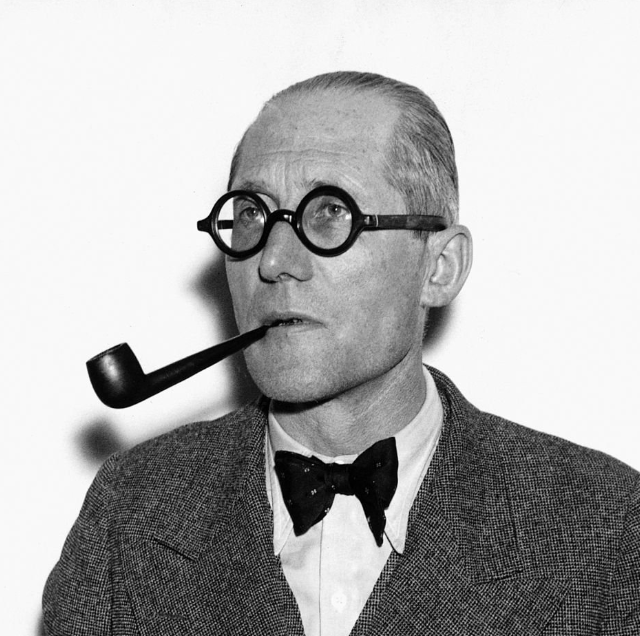
Le Corbusier (pseudonym of Charles-Édouard Jeanneret-Gris; born in La Chaux-de-Fonds, October 6, 1887 – died in Roquebrune-Cap-Martin, August 27, 1965) was a Swiss-French architect, urban planner, painter, sculptor, designer, and writer.
After studying at the École d'Art in his hometown and later attending the École des Beaux-Arts in Paris, he emerged as one of the foremost pioneers of the Modern Movement. Alongside his groundbreaking architectural and urban planning work—and his iconic interior furniture designs, often developed in collaboration with Charlotte Perriand and Pierre Jeanneret—Le Corbusier maintained a lifelong, intensive focus on painting and the plastic arts.
Collaborations with Murano Glass and Fucina degli Angeli
In the 1950s, Le Corbusier’s interest in material experimentation led him to engage with the Murano glassmaking tradition through the Venetian art promoter Egidio Costantini. In 1953, he joined Costantini’s initiative—initially founded as the Centro Studio Pittori nell'Arte del Vetro di Murano and soon renamed Fucina degli Angeli (Forge of the Angels) at the suggestion of Jean Cocteau—participating in its landmark inaugural exhibition alongside major modern masters such as Alexander Calder, Henry Moore, Oskar Kokoschka, and Virgilio Guidi.
Unlike his industrial furniture design, Le Corbusier’s work in Murano was dedicated not to functional objects, but to one-of-a-kind sculptures that translated the organic forms and objets à réaction poétique (objects of poetic reaction) of his painting and sculpture into glass:
- Armonie architettoniche (1954). Conceived by Le Corbusier for Fucina degli Angeli and executed by the Ferro Lazzarini glassworks, this piece synthesizes compositional rigor, luminous transparency, and the fluid plasticity of molten glass.
- Bucranio and Venezia. Throughout his collaboration with Costantini, Le Corbusier designed other notable mixed-media sculptures, including Bucranio (glass mounted on a wooden base within a Plexiglas case, exploring the tension between organic matter and spatial stillness) and Venezia (an assemblage of glass, metal, and Plexiglas offering an abstract, poetic interpretation of the lagoon city).
The technical realization of these works relied on the close dialogue between Le Corbusier’s designs and the virtuosity of Murano’s leading master glassmakers of the era—including Ermanno Nason and the artisans of the Ferro Lazzarini and Cenedese furnaces—marking a pivotal moment in elevating Murano glass from the decorative arts to contemporary sculpture.

Dejar un comentario
Todos los comentarios se revisan antes de su publicación.
Este sitio está protegido por hCaptcha y se aplican la Política de privacidad de hCaptcha y los Términos del servicio.