
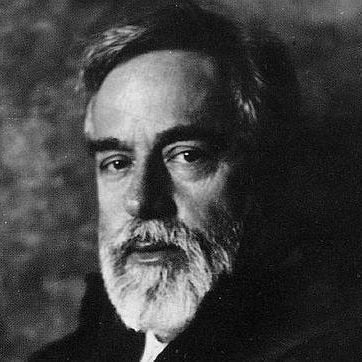
Granada, May 11, 1871 – Venice, May 1949
Mariano Fortuny y Madrazo was a Spanish painter, designer, photographer, stage designer, inventor, and entrepreneur who spent most of his professional life in Venice. The son of painter Mariano Fortuny y Marsal and a member of the Madrazo artistic family through his mother, he grew up in an environment deeply connected to the visual arts. After spending his formative years in Paris, he moved to Venice at the age of eighteen, where he became part of the city’s international artistic and cultural milieu.
His work encompassed a remarkably wide range of disciplines. Alongside painting, he explored photography, engraving, stage design, textiles, and, above all, the study of light. His interest in the theater of Richard Wagner led him to experiment with indirect lighting systems and to develop the celebrated Fortuny Dome, designed to replace traditional theatrical backdrops with illuminated surfaces capable of creating changing atmospheric effects.
Palazzo Fortuny in Venice
Beginning in 1898, Fortuny gradually occupied Palazzo Pesaro degli Orfei, a monumental late-Gothic building overlooking Campo San Beneto. When he first arrived, the palace was in a state of partial neglect. Fortuny initially transformed it into his studio and later into an extraordinary combination of private residence, workshop, factory, and experimental laboratory.
The palace still preserves a substantial part of the aesthetic world created by Mariano Fortuny and his wife and collaborator, Henriette Nigrin. Its vast Venetian rooms were furnished with printed fabrics, rugs, furniture, paintings, armor, books, and objects drawn from different historical periods and cultures.
In the great hall of the piano nobile, textiles cover or screen portions of the walls, while objects emerge from carefully controlled, theatrical lighting. Fortuny’s private library, with bookshelves partially concealed behind his own fabrics and filled with engravings, art books, technical studies, and decorative reference materials, has the atmosphere of a Wunderkammer, or cabinet of curiosities.

A Theatrical, and Oriental-Inspired Aesthetic
The interiors of Palazzo Fortuny cannot be attributed to a single decorative style. They combine references to the Venetian Renaissance, Islamic art, Eastern decorative traditions, classical culture, and the collecting sensibilities of the nineteenth century.
The result is an intentionally dense and theatrical environment. Dark woods, large expanses of fabric, velvet, rugs, gilded motifs, and deep colors absorb light rather than reflect it evenly.
Fortuny used darkness primarily as a means of shaping light. Dimly lit interiors intensified the reflections of gold, silk, glass, and patterned fabrics, creating an atmosphere suspended between an artist’s studio, a Venetian residence, and a theatrical set.
Central to this atmosphere are the Fortuny lamps, developed from his experiments with theatrical lighting. Silk shades, suspended forms, decorative patterns, and references to Eastern art transformed the light source itself into an integral part of the interior.

Fortuny favored indirect, diffused light, avoiding harsh or uniformly distributed illumination. Lighting solutions originally developed for the stage were later adapted for domestic interiors and, beginning in the 1920s, commercialized in the form of pendant, table, and floor lamps.
Textiles, Fashion, and Enterprise
Fortuny’s entrepreneurial activity emerged directly from his artistic research. Together with Henriette Nigrin, he developed techniques for treating, dyeing, pleating, and printing fabrics and created garments that became internationally renowned, most notably the pleated Delphos gown.
His textile experiments began at Palazzo Pesaro degli Orfei in the early twentieth century and eventually developed into an organized manufacturing operation. The historic Fortuny factory on the island of Giudecca became the center of his textile production, combining craftsmanship, technical experimentation, artistic design, and manufacturing.
Fortuny therefore anticipated a professional model that is familiar today but was highly unusual in the early twentieth century: the designer capable of controlling concept, technique, production, and the visual identity of the finished product.
The Fortuny textile tradition continues in Venice today, where fabrics are still produced at the historic Giudecca factory using processes derived from the methods developed by Mariano Fortuny.

Legacy
Mariano Fortuny died in Venice in 1949. Palazzo Pesaro degli Orfei was later donated to the City of Venice by Henriette Nigrin, with the intention of preserving its character as a place dedicated to art. Since 1975, it has been open to the public as the Fortuny Museum.
Fortuny’s significance lies not in any single discipline but in his ability to connect fields that were traditionally considered separate. Painting, fashion, textiles, theater, photography, interior design, and lighting became elements of a single aesthetic vision.
Palazzo Fortuny remains the most complete expression of that vision: not simply the home of an artist, but an environment conceived as a total work of art.
Note on the Date of His Death
Sources differ slightly regarding the exact date of Fortuny’s death. The Fortuny Museum/MUVE records May 2, 1949, while several biographical sources give May 3, 1949.
Official & Related Links
Museo Fortuny – Official Website
Information about Palazzo Fortuny, exhibitions, collections, and the museum.
Museo Fortuny – Official Website
Palazzo Fortuny – Museum House
A closer look at the historic interiors, rooms, works of art, and atmosphere of Mariano and Henriette’s home.
Explore the Museum House
Mariano Fortuny’s Ateliers
Official information on Fortuny’s textile experiments, photography, engraving, theater, lighting systems, lamps, and private library.
Explore Mariano Fortuny’s Ateliers
Museo Fortuny – Collections and Visitor Route
An overview of the palace, the museum house, and Fortuny’s workshops.
Explore the Museum Collections
Museo Fortuny – Visitor Information
Opening hours, tickets, and practical information for visiting Palazzo Fortuny in Venice.
Plan a Visit to Museo Fortuny
Fortuny – Official Textile Company
The historic Venetian textile house continuing the tradition of Fortuny fabrics from the original factory on Giudecca.
Fortuny – Official Website
Fortuny Factory & Showroom – Venice
Information about the historic Giudecca factory and Venice showroom.
Fortuny Venice Factory & Showroom


コメントを書く
全てのコメントは、掲載前にモデレートされます
このサイトはhCaptchaによって保護されており、hCaptchaプライバシーポリシーおよび利用規約が適用されます。