
The use of ultraviolet (UV) curing adhesives represents a specialized methodology in glass bonding. This technique is primarily recommended for professional operators, although it can be adopted by enthusiasts with meticulous adherence to procedure.
In the context of glass furnaces, UV adhesive bonding is gaining a significant role in production processes, offering a valid structural alternative to traditional hot joining. The efficacy of this bonding is directly proportional to the clarity and correctness of the application process.
The UV Adhesive for Glass Joints
The adhesive, after application, hardens (polymerizes) through exposure to UV radiation; it is also observed that an increase in temperature can act as an additional catalyst for the process.
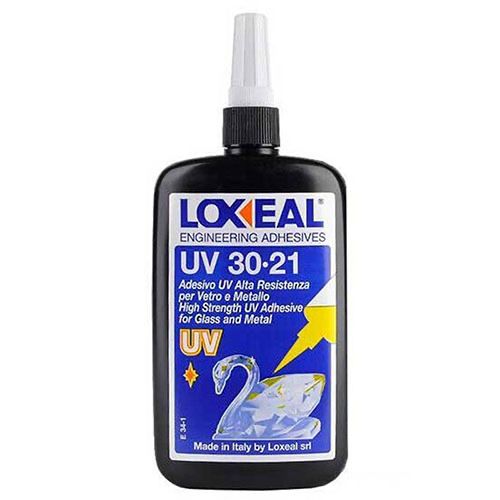
A reference product, widely used in furnaces for its toughness, is LOXEAL ADHESIVE UV hardener 30-21 (50ml), available through various e-commerce channels.
Critical Parameters for Polymerization
The degree of polymerization (and consequently, the final mechanical strength of the bond) is a complex function of multiple variables that must be precisely controlled:
- The intensity of the UV radiation source.
- The distance of the lamp from the bonding point.
- The thickness of the adhesive layer applied.
- The optical transparency of the material, as the UV radiation must pass through the substrate: greater glass transparency correlates with more complete polymerization and higher resistance.
- The specific geometry of the surface to be bonded.
Contraindications and Equipment
Due to its dependence on light transmission, UV adhesive is not recommended for:
- Opaque or colored glass, where absorption prevents effective polymerization.
- Joints with significant misalignment or surfaces requiring gap filling.
Since curing occurs exclusively under UV irradiation, the use of a specific, high-intensity UV source is essential. It is recommended that this source be capable of emitting radiation with a wavelength between $365 \text{ nm}$ and $420 \text{ nm}$, with a minimum intensity of $100 \text{ mW/cm}^2$.
Storage Instructions
To maintain the product's effectiveness over time, it is advisable to purchase only the amount of adhesive strictly necessary for immediate use. The product is photosensitive and must be strictly not exposed to light. For this reason, it is common practice, even after the container has been provided with shielding, to wrap it in an additional layer of opaque material (such as aluminum foil) after each use.
Related links:
What to use to repair glass

Leave a comment
All comments are moderated before being published.
This site is protected by hCaptcha and the hCaptcha Privacy Policy and Terms of Service apply.